
Why You Doubt Yourself Right After Making the “Right” Decision
What post-decision anxiety really means, and how to build self-trust when everything feels uncertain

Dear Quarter Lifer,
Have you ever made a big decision and instantly questioned everything?
I’m not talking about impulsive decisions made from anxiety, comparison, or a false sense of urgency (which, if we admit to ourselves, we know deep down never felt right in the first place).

I’m talking about those decisions that felt so aligned, so thought out, so settled and expansive in your chest. Those that were initially even hard to make, but you did it! You crossed the bridge and you felt good and proud about yourself for a second, until the anxiety and doubt crept in. Until you found yourself in this strange, new, uncertain place, and suddenly there is this voice in your head criticizing your every move — not just that one decision — when only just moments ago you felt so sure this was right for you.
If this is you — or has been you at some point — don’t worry, you’re not alone. It’s something normal to experience in our 20s, a decade characterized with multiple life transitions and big decisions, and something I have been dealing with a lot lately. Let’s start by calling that nagging, negative voice in your head that makes you doubt your every move by its name: lack of self-trust.
I’m in my late twenties, and after almost a decade of moving countries, overcoming bad relationships and friendship breakups, solo traveling, and pivoting careers, I thought my self-trust was rock solid.
Especially after last year, when I decided to create Off-Script Club, a platform that helps quarter lifers get unstuck and create lives they actually love. I thought I had made the most difficult, life-altering decision already and what came after would be easier.
But what nobody tells you is that, while making that first decision is hard, the most difficult part is the follow-through, the maintenance, the moments when you’re thrust into the uncertainty that comes with new territory and oftentimes even a new identity.
Two things can happen in these moments: 1) your fear and need for safety drive you to throw the towel or 2) you build trust in yourself and take the next small step forward, trusting (for the lack of a better word) in your ability to recalibrate when things don’t go your way.
This is where the magic happens.
The science behind building self-trust
In those moments of in-between that lead you to question every decision you and your ancestors have ever made, why is grounding in self-trust so hard? The answer lies in your brain’s biology.
Your brain is made from millions of connections between neurons. Through these connections, neurons transmit electrical and chemical signals along your nervous system, which allows you to think, move, and feel.
They aren’t permanent though; a process called neuroplasticity allows the brain to reorganize its structure and function through learning and experience.
Neuroplasticity follows a simple rule: neurons that fire together wire together. Every time you repeat the same action, the same neurons fire together1. In other words, practice makes perfect AND new neural connections.
This is why driving the same route to work or brushing your teeth doesn’t take you on a downward spiral — they are actions you have repeated over and over, and have well-established neural connections in your brain. You identify with a person who does these things. Thus, these actions feel safe, trustworthy.
But when you’re faced with a new situation, the neural connections are not there yet or they might be in their early stages. Your new identity hasn’t yet formed, and the panic sets in.
But it doesn’t mean you’ve made the wrong decision, it just means you have to put in the reps so you can start feeling like the ground below you is solid.
Showing up = building self-trust
Here’s what nobody tells you about building self-trust (or any kind of trust, really):
It does not require you to make bold moves or grand gestures. Unfortunately, your life is not a romcom. Some grand gesture won’t build your self-trust back or fix anything. This is just a sure-fire way to burn out and throw the towel at the beginning of your self-trust journey.

All that it requires is that you show up, over and over, in the small ways. That you build evidence, step by step, that you are a person who can operate under this new arena you’re in.
Think about it this way: if your partner broke your trust and showed up with a fancy dinner and a big bouquet of roses — would you trust them again immediately? Probably not. It’s a nice gesture, but trust doesn’t come back in one big moment. It comes back when someone shows up, consistently, day after day. And building self-trust works the same way.
This is how new neural connections and new identities form. Every time you take the next small step and show up, neurons are firing and wiring together, and in doing so, you are becoming someone who can figure it out as they go, and be okay.
I know that this is simple to comprehend, yet hard to put in practice. I struggle with it all the time. So, here are some steps I started taking to put in the reps more easily, and maybe they will work for you too:
Get clear. What do you value? These values are the reason “why” you act a certain way. They are your north star. If you’re not sure where to start, take a look at this list of values by Brené Brown and pick 3-5. It is not all encompassing, but it is a good starting point.
Map the path. Now, using your values as your compass, ask yourself these 2 questions: what do I want? and what will I do to get there? I know these questions can be a lot. Just let yourself imagine for a moment and ignore all the reasons you tell yourself why something can’t happen for you. This doesn’t have to be a grand 5-year plan, it can be as simple as looking an hour, day, week, or month into the future, depending on your situation. If this is still too much, then ask yourself: what am I willing to explore without needing the answer first?
Gain confidence through evidence. Remind yourself that you’re not starting from zero. What are other difficult moments where you have acted with self-trust? How can you translate that trust into your current situation and what you want to do?
Brainstorm contingencies. Having a backup plan often helps our brain calm down. Write one or two ways you could pivot and adapt if things went sideways. Then calmly reason with yourself: if any of those pivots happened, would it be the end of the world? The answer is more than likely a no.
Get going + figure it out. Take the next small step. When things don’t go as planned (because they usually don’t), put your contingencies in motion or figure out a new way forward. No matter what, stick to your values.
“It is not the size of the action that builds your trust; its the gesture of honoring your values to any degree.” - Dr. Katherine Morgan Schafler
Practice metacognition. Think about how you think, which will help you understand how you learn best, choose better strategies, and strengthen those baby neural connections. I love the Plus Minus Next Method by Dr. Anne-Laure LeCunff for metacognition practice.
Repeat. Put in the reps, even if you fail — especially if you fail. Apply your lessons from your metacognition practice and do better (or different) next time.
“Trusting yourself is not something that happens to you; it’s a choice you make and support through action over time.” - Dr. Katherine Morgan Schafler
I love this quote because it exposes the three most important things to understand about building self-trust:
It is a choice. If you don’t actively decide to build that self-trust, your autopilot will choose for you, and that choice will most likely be to take the path of least resistance and throw the towel.
You must support that choice with action. Choosing by itself is not enough, which is why you have to show up. Every rep builds more trust.
This happens over time. Building self-trust is not something you do once. It is a process that requires weeks, months, or even years depending on the person and the situation. Don’t let this deter you, though. Good things take time, and you will start reaping the benefits somewhere along the way, not just at the end (spoiler alert: there is no end).
Building self-trust doesn’t end, it upgrades
I thought I already trusted myself and I’m still questioning everything.
That’s the boat I found myself in when testing out my first Off-Script Club prototype with a pilot cohort.
I had worked myself to the bone building the “perfect” platform, then fell on my ass countless times as things went wrong, people didn’t do what I expected them to, and I doubted whether I was cut out for this. I re-worked the entire platform in one day mid-cohort, then decided to trust my original instincts and undid all that work.
This experience made me question whether I had any self-trust at all, where before it was something I was so sure of. When I hit my lowest point, I decided to give stream of consciousness journaling — a tool to braindump all the junk and ideas from your mind into paper in 15 minutes to stop overthinking — a try, and a surprising realization came out:
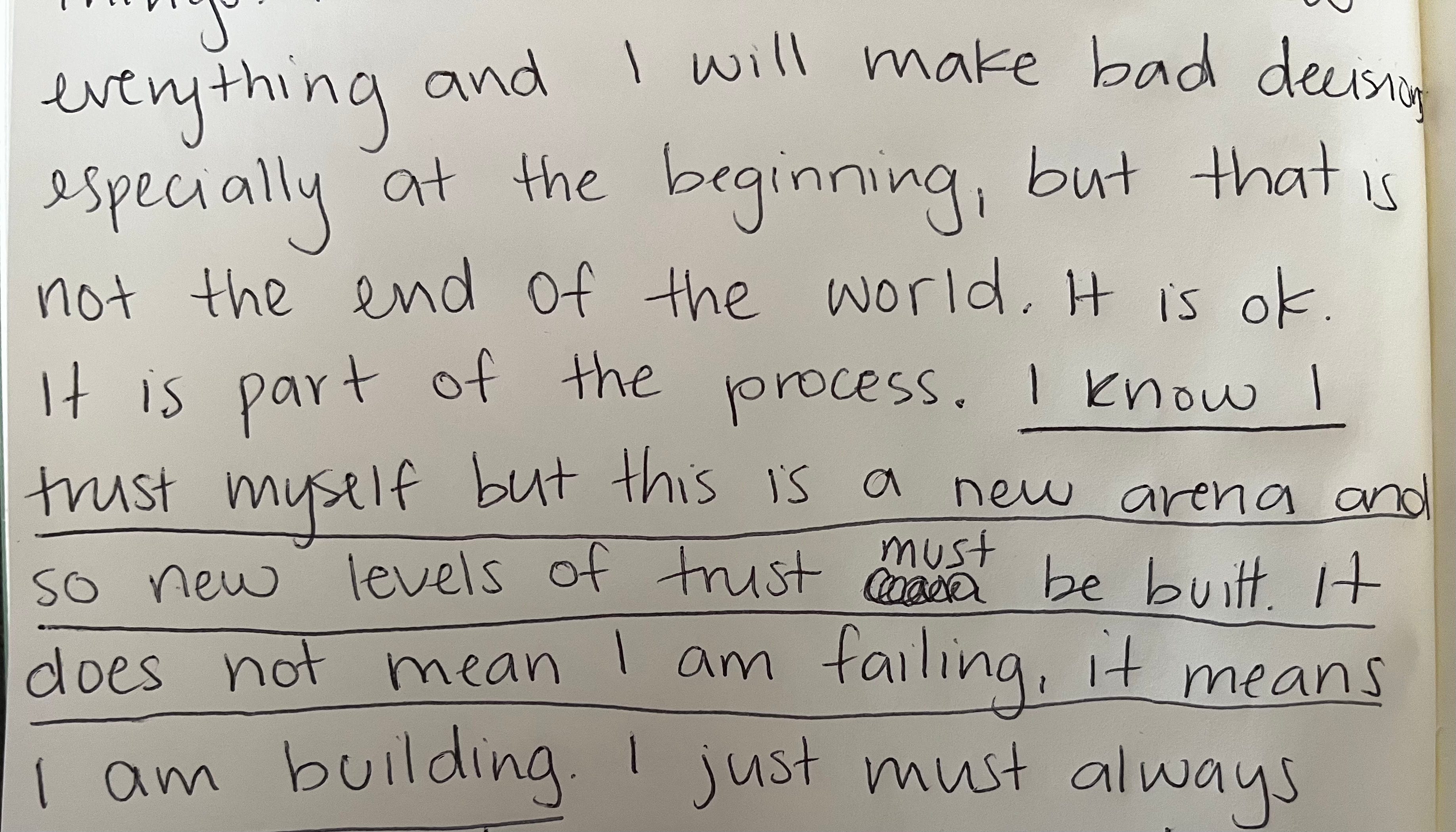
When you’re faced with new situations due to decisions you made acting with self-trust, then feel like that self-trust is gone, it is not that it suddenly left you or that you never had it in the first place; it means that you are in a new arena, which requires upgrading that trust.
Like a character in a videogame, you have unlocked a new level that is more difficult than the last, requiring more resources and complexity.
So when you start doubting yourself, I hope you catch yourself. I hope you can anchor in that self-trust that got you there to begin with, and not see it as a failure or as a sign you “chose wrong”. Instead, I hope you see it as a sign you’re becoming — one neural connection at a time.
With love,
Lucy
Your Quarter Life Pen Pal
Doidge, N. (2007). The brain that changes itself: Stories of personal triumph from the frontiers of brain science. Viking.