
You’re not lost, you’re becoming
Everyone tells you your 20s are for finding yourself. But what if getting lost is the point?

Dear Quarter Lifer,
Over a year ago I landed in my home country, Costa Rica, after visa issues dismantled the life I had worked so hard to build over seven years in NC, USA. I had no idea what to do next, so I decided to solo travel for a year to “find myself” (whatever that means). Even though I was fulfilling my life long dream to solo travel, I still wanted to become a puddle of goo and melt into the dirt. The uncertainty I was facing in my life weighed on me like a mountain I had no idea how to start climbing. I had never felt so lost.
Back in the USA I’d had everything I thought I should want: the college degree, the job that looked good on paper, a beautiful apartment in downtown, and financial stability. This is everything I had worked towards since graduating high school, but inside something felt off. Still, I didn’t leave willingly because this is what I was supposed to do, right?
Even though I wasn’t stoked about the life I’d left behind, grief cracked me open. I grieved the life I’d had, but also the person I thought I’d be. It forced me to admit that the life I’d so carefully crafted didn’t fit—and to stop pretending that it did. My whole life I’d been a planner. I knew exactly who I was, what I wanted to do, and how to go about it. But for the first time the path before me not only became murky—it disappeared altogether.
Although feeling lost feels like the loneliest experience ever, many of us experience this feeling in our quarter life era. We often feel lost because of grief or a perceived sense of loss. This is the chapter of life where transitions come in waves—we grieve the jobs, people, places, and possibilities we leave behind. Breakups. Deaths. Futures that suddenly close off. Identities that dissolve. Grief is everywhere, and most of us were never taught how to carry it.
I didn’t “find myself” while solo traveling (surprise!), but it did change me. It helped me understand something I had been too blind with panic and grief to comprehend: that uncertainty is not a crisis—it’s an opportunity. It made me feel lost, yes, but it also forced me to let go of everything that wasn’t for me, so that I could figure out what was.
What if getting lost is the point? I thought.
What if instead of looking at the murky ground before me, I could lift my gaze and wonder at the view?

The neuroscience behind feeling lost
At the time, I thought I was broken. Turns out, my brain was just doing its job.
Hating uncertainty doesn’t mean you’re failing at life—it means your brain is doing exactly what it was built to do. When we face uncertainty, our brain lights up certain regions in its salience network: the insula, amygdala, and anterior cingulate cortex (ACC). These regions detect what’s important and flag potential risks, increasing the likelihood that our brain treats uncertainty as potentially threatening. In short, our brain is trying to protect us1.
Our brain runs on predictions and mental models—internal representations of our external reality made up of our beliefs, experiences and knowledge that helps us navigate our world. It constantly compares what it expects about the future with what actually happens—like a GPS recalculating after every wrong turn. When life throws you off script, prediction errors pile up, and panic kicks in.2 3
That’s predictive coding: higher brain areas make predictions; lower ones report back how wrong those predictions were (aka prediction errors). The ACC monitors these “errors,” helping us update strategies and learn from what’s new.4 5
When life feels predictable, the brain’s prediction errors are small—you feel safe and in control. But when life gets uncertain, the errors spike, our mental models become insufficient, and the brain interprets that gap as danger. The good news: we can work with this system. If we learn how to recalibrate it, uncertainty can become the very place where growth happens.
And dopamine helps us do just that. Dopamine—the chemical messenger behind motivation, learning, and reward—helps the brain assign value, predict rewards, energize effort towards them, and decrease prediction errors 6. But not all dopamine is created equal.
Cheap dopamine engagement with exploitation decision-making fuels habits and comfort. It’s the scroll, the binge, the routine—familiar, easy, and safe.
Goal-directed dopamine engagement with exploration decision-making fuels curiosity and exploration. It’s the spark that makes us test, learn, and expand our mental models when life feels uncertain. 7 8
Our default is to stay in exploitation mode—doing what feels familiar and safe, even if it keeps us stuck. But to grow through uncertainty, we have to switch on exploration mode. That’s where curiosity comes in.
Curiosity doesn’t just make life more interesting—it literally rewires our brain. It reduces prediction errors, improves learning, and quiets the brain’s panic regions (insula and amygdala) while increasing engagement in the prefrontal cortex. In other words, curiosity helps you shift from crisis to opportunity.9 10
From Theory to Action
Before we can get curious, we have to calm the chaos inside.
Try this to regulate your nervous system: diaphragmatic breathing technique recommended by Dr. Daniel Amen. Place a hand on your belly. Inhale for four seconds, hold for two, exhale for eight, hold for two. Let your belly rise and fall. Do this for a minute or two, until your body softens and your mind feels less frantic, and try doing this every day a few times a day. You’re literally quieting your amygdala and turning your prefrontal cortex back online.
Now that the alarm bells are lower, we’re ready to activate curiosity.
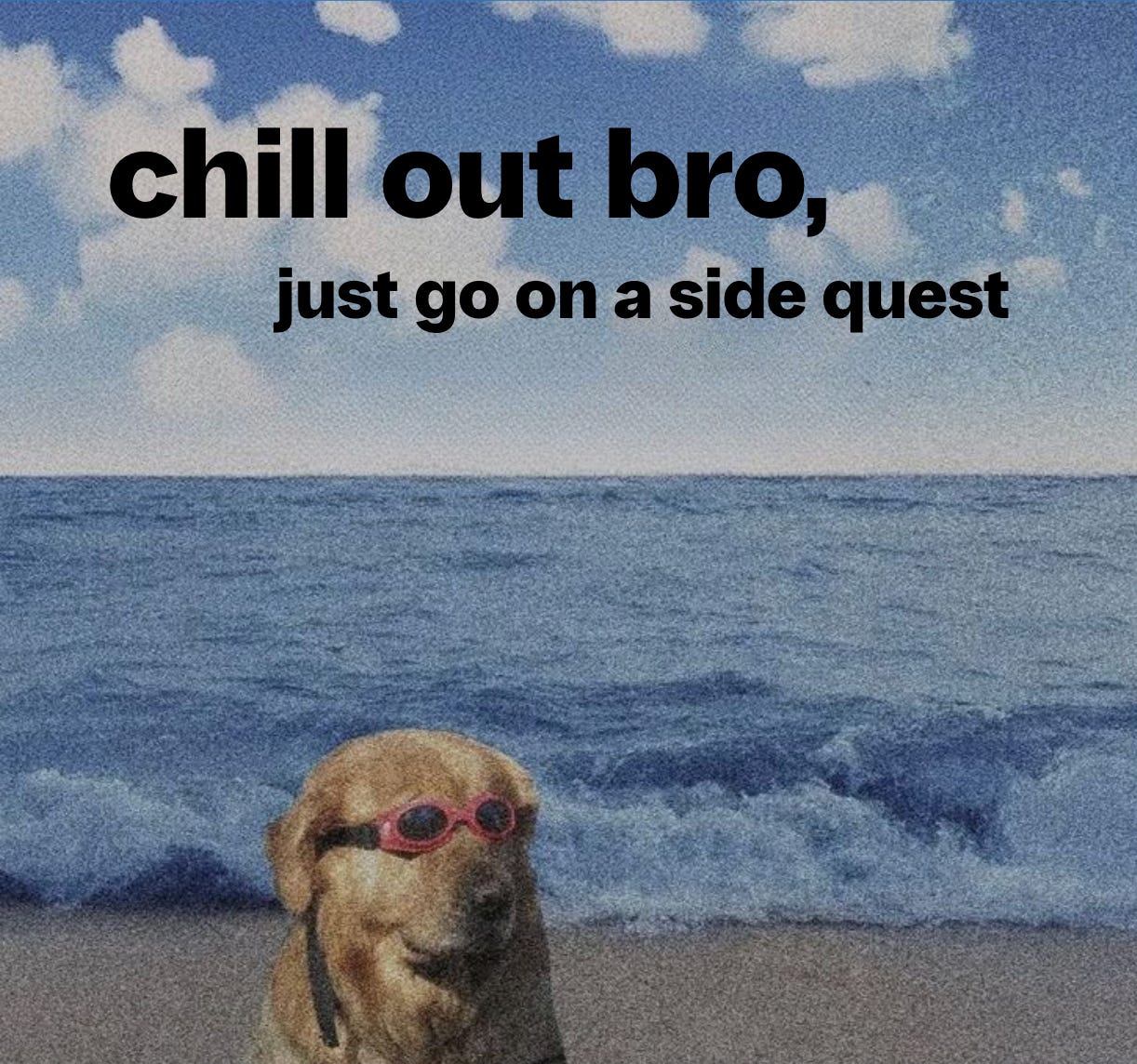
Enter: side quests.
If life is a story, we’re the main character—so we gotta stop acting like a background prop. Here’s how to start:
Lean into your curiosity
Identify one to three things that spark your curiosity.
If nothing comes to mind, spend a week as a scientist of your own life. Observe what catches your attention. Write it down.
Focus on curiosity, not passion. Curiosity is lighter—it doesn’t come with the pressure of “this must be my thing.”
Go on the side quest
Choose one curiosity and turn it into a side quest. Determine the what, how, and when. Optional: recruit someone to accompany you on your side quest.
I will [action] [frequency] for [duration].
For example if creative writing peaks your curiosity, your side quest might look like this:
“I will write one short story and show it to a friend every week for one month.”
For more details, follow Dr. Anne Laure LeCunff’s PACT system.
Don’t overthink it. The main quest—whatever’s making you feel lost—can wait. Just take the next small step.
Reflect as you go
After each side quest session, check in: What went well? What didn’t? What did I learn about myself? I love the Plus Minus Next Method by Dr. Anne-Laure LeCunff for quick reflections.
As you explore you will naturally shift from exploration to exploitation mode, which will help us form habits and persist through the changes. That’s how curiosity becomes clarity. Without this balance, we might get stuck in restless exploration without reaping any of the benefits.
Once you’ve reached your duration goal, reflect: do you wanna keep going on this side quest and further incorporate it into your life in a way that feels more meaningful? Or is this just not for you and you’d rather explore other side quests?
The point of these side quests isn’t just to make uncertainty bearable—it’s to make it transformative. Every small action increases dopamine, deepens learning, and helps you imagine success more easily. It becomes a feedback loop that builds momentum. Before you know it, you’re spiraling upward—the kind of spiraling we want to be doing.
And if you need convincing, remember this:
At worst, you find a new hobby and learn more about yourself. Maybe you meet new friends and become a part of a community you love.
At best, you find something that lights your ass on fire—and the side quest becomes the main quest.
To keep yourself accountable:
Involve friends or family.
Leave your side quest in the comments and update us on your progress.
Or email me at luciana@off-script.club. I promise to write back—I love pen pals.
Maybe sometimes we have to get lost. It is a wake up call.
It is the moment we stop pretending something’s working when it’s not.
It is an invitation to let go of what doesn’t serve us and explore what does—so that we can become a truer version of ourselves.
Next time you feel lost remember this:
You’re not lost. You’re becoming.
With love,
Your Quarter Life Pen Pal
Sarinopoulos, I., Grupe, D. W., Mackiewicz, K. L., Herrington, J. D., Lor, M., Steege, E. E., & Nitschke, J. B. (2010). Uncertainty during anticipation modulates neural responses to aversion in human insula and amygdala. Cerebral cortex (New York, N.Y. : 1991), 20(4), 929–940. https://doi.org/10.1093/cercor/bhp155
Sun, S., Yu, H., Yu, R. et al. Functional connectivity between the amygdala and prefrontal cortex underlies processing of emotion ambiguity. Transl Psychiatry 13, 334 (2023). https://doi.org/10.1038/s41398-023-02625-w
Rao, R. P., & Ballard, D. H. (1999). Predictive coding in the visual cortex: a functional interpretation of some extra-classical receptive-field effects. Nature neuroscience, 2(1), 79–87. https://doi.org/10.1038/4580
Sun, S., Zhen, S., Fu, Z., Wu, D. A., Shimojo, S., Adolphs, R., Yu, R., & Wang, S. (2017). Decision ambiguity is mediated by a late positive potential originating from cingulate cortex. NeuroImage, 157, 400–414. https://doi.org/10.1016/j.neuroimage.2017.06.003
Lerner, T. N., Holloway, A. L., & Seiler, J. L. (2021). Dopamine, Updated: Reward Prediction Error and Beyond. Current opinion in neurobiology, 67, 123–130. https://doi.org/10.1016/j.conb.2020.10.012
Schultz W, et al. Dopamine, Prediction Error and Beyond. Trends Neurosciences. 2021;44(2):85–97. [doi:10.1016/j.tins.2020.12.001]
Cremer, A., Kalbe, F., Müller, J.C. et al. Disentangling the roles of dopamine and noradrenaline in the exploration-exploitation tradeoff during human decision-making. Neuropsychopharmacol. 48, 1078–1086 (2023). https://doi.org/10.1038/s41386-022-01517-9
Chakroun, K., Mathar, D., Wiehler, A., Ganzer, F., & Peters, J. (2020). Dopaminergic modulation of the exploration/exploitation trade-off in human decision-making. eLife, 9, e51260. https://doi.org/10.7554/eLife.51260
van Lieshout LLF, Vandenbroucke ARE, Müller NCJ, Cools R, de Lange FP. Induction and Relief of Curiosity Elicit Parietal and Frontal Activity in the Human Brain. Cerebral Cortex. 2018 Mar;28(3):1–19. [doi:10.1093/cercor/bhx233]
Gruber MJ, Gelman BD, Ranganath C. States of Curiosity Modulate Hippocampus-Dependent Learning via the Dopaminergic Circuit. Neuron. 2014 Oct 29;84(3):486–96. [doi:10.1016/j.neuron.2014.08.060]